What Is a Safety Monitor and Why Are They Important for Lone Workers?
Table of Contents
- What Is a Safety Monitor?
- Why Safety Monitors Matter for Lone Workers
- The Legal and Compliance Context for Safety Monitors
- What Effective Safety Monitors Must Deliver
- MyLoneWorkers: A Complete Safety Monitor Platform for Lone Workers
- Core Safety Monitor Features of MyLoneWorkers
- Operational Features That Complement the Safety Monitor Platform
- Building a Safety Monitor Culture in Field Operations
- Conclusion: Safety Monitors Are Non-Negotiable for Lone Worker Protection
In any workplace where employees operate without direct supervision — in the field, on remote sites, during overnight shifts, or in isolated facilities — the question of who is watching over them becomes critical. The answer, in modern lone worker safety frameworks, is a safety monitor: the system, platform, or designated function that maintains continuous oversight of workers operating alone and responds when something goes wrong.
Understanding what a safety monitor is, how it works in practice, and why it is indispensable for lone worker protection is increasingly important for businesses across high-risk industries. In 2026, the expectation of regulators, insurers, and courts is that businesses with lone workers have robust safety monitors in place — not informal arrangements or ad hoc check-in calls, but systematic, technology-supported oversight that operates continuously and escalates automatically.
This article explains exactly what a safety monitor is, what distinguishes effective safety monitors from inadequate ones, and how MyLoneWorkers delivers the most complete safety monitor platform available for businesses with remote and field-based workforces.
What Is a Safety Monitor?
A safety monitor is any person, system, or technology solution responsible for tracking the wellbeing, location, and status of workers who operate alone or in high-risk conditions, and for initiating a response when those workers need assistance.
In traditional lone worker arrangements, a safety monitor might have been a colleague or supervisor who periodically called field workers to confirm they were safe. In practice, this informal model is unreliable — dependent on human memory, shift availability, and the assumption that a lack of response is noticed and acted upon promptly.
In 2026, a safety monitor is most effectively understood as a technology platform: a cloud-based system that maintains real-time visibility of lone workers through GPS tracking, automated welfare checks, emergency alerting, and passive incident detection — and that escalates automatically when the expected signals from a worker are absent or when an emergency is detected.
For anyone asking what's a monitor in the context of lone worker safety, the answer has evolved substantially. Modern safety monitors are not passive observation tools. They are active, intelligent systems that combine hardware sensors, mobile applications, cloud infrastructure, and automated alerting to maintain a continuous protective connection between the lone worker and the people responsible for their safety.
Safety monitors in the technology sense operate across three dimensions:
 Passive monitoring — continuously tracking location, movement, and posture without requiring any action from the worker. Man-down detection is the defining example: a sensor detects incapacitation and triggers an alert automatically.
- Active monitoring — requiring periodic input from the worker to confirm their safety. Welfare checks are the primary mechanism: the worker confirms their wellbeing at defined intervals, and missed confirmations trigger automatic escalation.
- Event-driven monitoring — responding immediately to specific actions or triggers, such as an SOS button press, a geofence breach, or a checkpoint scan. The safety monitor platform receives these signals in real time and routes them to the appropriate response team.
Why Safety Monitors Matter for Lone Workers
The importance of safety monitors for lone workers is rooted in a simple but profound operational reality: when something goes wrong for a worker who is alone, there is no one present to notice, to help, or to call for assistance. The only reliable substitute for a colleague standing beside the worker is a safety monitor system maintaining continuous digital oversight.
Without safety monitors, the timeline of a lone worker incident is determined by chance. When will someone next attempt to contact the worker? How long before their absence is noticed? How much time passes between the incident occurring and emergency services being dispatched? In documented cases of lone worker fatalities that occurred without adequate monitoring in place, those intervals have ranged from one hour to an entire shift.
With effective safety monitors in place, that timeline is compressed dramatically. An automated welfare check missed by three minutes generates an alert. A man-down sensor triggered by a fall dispatches a notification within seconds. An SOS pressed by a worker in distress reaches the monitoring center immediately with precise location data. The safety monitor system does not wait for someone to notice something is wrong. It identifies the problem at the moment it occurs and initiates the response chain instantly.
This compression of response time is the fundamental value of safety monitors for lone workers — and the reason why they have become a baseline expectation rather than a premium feature in high-risk industries.
The Legal and Compliance Context for Safety Monitors
For businesses with lone workers, safety monitors are not only good practice. In most jurisdictions, they are a legal obligation.
In the UK, the Health and Safety at Work Act 1974 and the Management of Health and Safety at Work Regulations 1999 require employers to assess the specific risks of lone working and implement appropriate controls. HSE guidance explicitly references monitoring arrangements as a key control measure for lone workers. EU frameworks and OSHA standards in the United States carry equivalent requirements.
The regulatory expectation in 2026 is that safety monitors for lone workers are systematic and technology-supported — not reliant on manual processes that are vulnerable to human error, shift changes, and competing priorities. Businesses that cannot demonstrate evidence of structured safety monitors — timestamped records, automated alert logs, documented response procedures — face enforcement action, financial penalties, and civil liability exposure when incidents occur.
Safety monitors also play a critical role in insurance. Insurers increasingly expect to see evidence of systematic lone worker monitoring as a condition of coverage in high-risk sectors. A business that suffers a serious lone worker incident without adequate safety monitors in place may find its insurance position significantly compromised.
What Effective Safety Monitors Must Deliver
Not all safety monitors provide the same level of protection. Understanding what's a monitor that genuinely meets the needs of lone workers — versus one that provides superficial compliance — requires evaluating several core capabilities:
- Continuous real-time location tracking. Effective safety monitors maintain an up-to-date picture of where each lone worker is at all times — using GPS, Wi-Fi, and GSM data to provide accurate positioning indoors, outdoors, and in remote areas.
- Passive emergency detection. The most important capability of any safety monitor is the ability to detect emergencies without requiring the worker to act. Man-down sensors that trigger alerts automatically when a worker falls or is incapacitated are the gold standard.
- Automated welfare checks with escalation. Safety monitors must automate the check-in process, treating missed responses as emergency signals and escalating to managers immediately — without depending on human memory or manual follow-up.
- Multi-channel active alerting. Workers must be able to raise an alarm through their smartphone and through a physical panic device — ensuring that safety monitors function even in environments where phone access is impractical.
- Geofencing. Virtual boundaries around job sites and restricted zones allow safety monitors to generate passive situational awareness alerts without requiring any action from the worker.
- Compliance-grade audit logging. Every interaction with the safety monitor system must be automatically recorded — creating the timestamped evidence that regulatory, insurance, and legal processes require.
- Operational integration. The best safety monitors integrate with scheduling, attendance, asset management, and reporting tools — giving businesses a unified platform rather than a standalone safety silo.
MyLoneWorkers: A Complete Safety Monitor Platform for Lone Workers
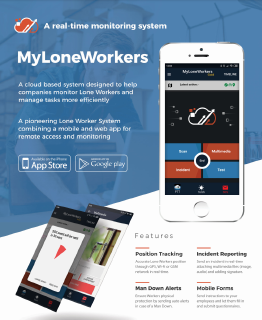
MyLoneWorkers is a cloud-based safety monitor platform designed specifically for businesses with field operations and remote workforces. Combining a real-time web management dashboard with native Android and iOS mobile applications, it delivers the full spectrum of safety monitors capability — from passive man-down detection to automated welfare checks, SOS alerting, geofencing, and AI-powered reporting — in a single integrated solution.
MyLoneWorkers is the answer to what's a monitor that genuinely protects lone workers in high-risk environments in 2026. It is not a generic workforce tool with monitoring features added as an afterthought. It is a safety monitor system built from the ground up for the specific hazards and operational realities of lone and remote working.
Test MyLoneWorkers for Free
Discover how MyLoneWorkers protects lone and field workers with man down alarms, real-time monitoring, and automated safety alerts. No installation or commitment required.
Core Safety Monitor Features of MyLoneWorkers
Man Down Alert: The Passive Safety Monitor Layer
The Man Down feature delivers the most critical passive capability of the MyLoneWorkers safety monitor platform. A sensor clip worn on the worker's uniform continuously monitors movement and posture in real time. When the sensor detects that a worker has collapsed, fallen, or remained motionless in a position consistent with incapacitation, it automatically dispatches a Man Down notification to the Monitoring Center — without any action required from the worker.
This passive, automated response is what separates a genuine safety monitor from a basic check-in application. When a lone worker suffers a sudden medical event or is physically unable to raise an alarm, the safety monitor raises the alarm on their behalf — initiating the emergency response chain at the moment of incident rather than minutes or hours later.
Welfare Check: The Active Safety Monitor Cycle
The Welfare Check feature automates the time-based safety monitor cycle that is essential for structured lone worker protection. Managers define check-in intervals appropriate to each worker's role and risk profile. When a worker fails to complete their welfare check within the defined window, the MyLoneWorkers safety monitor platform immediately generates an alert and notifies managers via the web application and email.
The design principle is fundamental to any serious safety monitor implementation: silence is not accepted. Every missed check-in is treated as a potential emergency and escalated immediately — not noted and followed up when convenient.
SOS Alert and Test Alert
When a worker can act — recognising a developing threat before it escalates — the SOS button in the MyLoneWorkers safety monitor application sends an immediate alarm to the Monitoring Center with precise GPS coordinates. Up to three designated contacts receive simultaneous SMS notifications, ensuring a multi-channel response that reaches the right people instantly.
The Test Alert function allows workers to confirm that every element of the safety monitor setup — device, connectivity, location data, and configuration — is functioning correctly before a shift begins. This pre-shift verification builds confidence in the system and reduces the risk of technical failures when the safety monitor is needed most.
External BLE Panic Button: Physical Safety Monitor Access
For environments where smartphone access is impractical under pressure — confined spaces, heavy protective gear, fast-moving security patrols — the external Bluetooth Low Energy (BLE) panic button provides a physical safety monitor trigger that workers carry as part of their standard equipment.
A single press dispatches a real-time SOS to the Monitoring Center immediately. This physical device ensures that the safety monitor platform functions in the most demanding real-world conditions — not only in scenarios where the worker has easy access to their phone.
Together with the mobile SOS, it creates a dual-layer active alerting system that removes single points of failure from the safety monitor architecture.
Geofence Alerts: Boundary-Aware Safety Monitoring
The geofencing feature allows managers to configure virtual geographic boundaries around job sites, restricted zones, and permitted working areas. The MyLoneWorkers safety monitor platform generates automatic alerts when a lone worker enters or exits a defined geofence — adding a continuous passive situational awareness layer that operates independently of active check-ins and SOS alerting.
For businesses managing workers across large sites, multiple locations, or environments with specific access control requirements, geofencing is an essential dimension of comprehensive safety monitors for lone workers.
Real-Time Checkpoint Scanning
Using NFC tags, Beacons, QR codes, and virtual checkpoints placed at specific locations, workers log their presence and task completion in real time through the MyLoneWorkers mobile application. Each scan sends timestamped GPS data to the web dashboard via a secure cloud server. Workers can enrich each checkpoint scan with photos, voice notes, written notes, and signatures — building a detailed operational audit trail that complements the safety monitor data stream with verifiable field activity records.
AI Reports: Intelligence Powered by Safety Monitor Data
The AI Reports feature transforms the continuous data generated by the safety monitor platform into immediately actionable management intelligence. Managers ask natural-language questions directly inside MyLoneWorkers — "Show all missed welfare checks this week", "Which workers triggered SOS alerts this month?", "List all Man Down incidents in the last 30 days?" — and receive instant, structured answers.
For operations managers overseeing large dispersed workforces, AI-powered reporting turns safety monitor data into proactive risk management rather than reactive incident review. Patterns are surfaced, anomalies are identified, and decisions are made on the basis of evidence rather than assumption.
Operational Features That Complement the Safety Monitor Platform
MyLoneWorkers extends its safety monitor capabilities with operational tools that integrate safety and business management in a single platform:
- Time & Attendance provides real-time tracking of shift check-ins, check-outs, working hours, and breaks — fully integrated with the safety monitor infrastructure so that attendance and safety data are managed in one place.
- Asset Tracking allows managers to register and monitor physical assets — keys, equipment, devices — tracking custody chains, issue dates, and return schedules. Complete accountability without a separate system.
- SafePass extends the MyLoneWorkers safety monitor protection model to VIPs and designated clients through a dedicated mobile application — supporting executive protection operations and businesses with client-facing safety obligations.
Building a Safety Monitor Culture in Field Operations
Technology alone does not create a complete safety monitor framework. The most effective implementations combine the automated capabilities of the MyLoneWorkers platform with clear operational policies, transparent communication with workers about how the safety monitor system works and why it is in place, and consistent management response to the alerts it generates.
Workers who understand that their safety monitor system exists to protect them — not to surveil them — engage with it more consistently and reliably. Managers who respond promptly and visibly to every welfare check alert and SOS signal reinforce the message that the safety monitor is taken seriously at every level of the organisation.
When technology and culture work together, safety monitors do not just detect emergencies. They change the risk profile of lone working entirely — by creating the visible, systematic accountability that makes incidents less likely to occur and far less likely to go undetected when they do.
Optimize Your Scheduling with Workeen AI
Transform your workforce management with Workeen AI, the AI-powered shift management system designed to simplify scheduling for industries with round-the-clock operations. Effortlessly create efficient rosters, manage unexpected absences, and ensure fair work distribution with predictive insights and real-time updates. Boost productivity and compliance while keeping your team informed through instant communication tools.
Conclusion: Safety Monitors Are Non-Negotiable for Lone Worker Protection
For any business with employees working alone in 2026, the question is not whether safety monitors are needed. The question is whether the safety monitors in place are adequate for the risks the workforce faces.
MyLoneWorkers delivers the most complete safety monitor platform available — combining passive Man Down detection, automated welfare checks, SOS alerting, physical panic button hardware, geofencing, and AI-powered reporting in a single cloud-based solution designed specifically for lone and remote workforces.
Because every lone worker deserves a safety monitor that is always watching, always ready, and never caught off guard.
Explore MyLoneWorkers and request your free demo today.
About MyLoneWorkers
MyLoneWorkers innovative system reduces the risks and guarantees that every lone worker returns home safely after carrying out their tasks at work which is one of the most basic responsibilities for an employer. It is a real time lone worker monitoring system which skyrockets the efficiency of lone workers’ safety and the completion of their tasks offering them the ability to increase their productivity via technology.