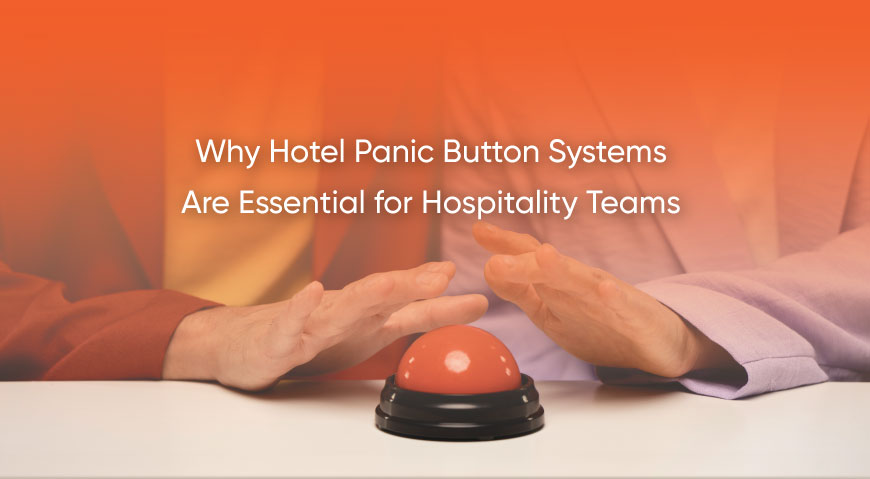
Why Hotel Panic Button Systems Are Essential for Hospitality Teams
Table of Contents
- The Real Safety Risks Facing Hospitality Workers
- The Regulatory and Legal Context for Hotel Panic Buttons
- What a Hotel Panic Button System Must Deliver
- MyLoneWorkers: A Complete Hotel Panic Button and Lone Worker Safety Platform
- The MyLoneWorkers External BLE Panic Button: Hotel Panic Button Hardware Built for the Field
- SOS Alert via the MyLoneWorkers Mobile App
- Welfare Check: Scheduled Safety Monitoring for Hotel Staff
- Man Down Alert: Passive Protection Beyond the Hotel Panic Button
- Geofence Alerts: Location-Aware Safety for Large Hotel Properties
- Real-Time Checkpoint Scanning for Hotel Operations
- AI Reports: Intelligence Across the Hotel Panic Button Platform
- Additional Features for Hospitality Operations
- Why MyLoneWorkers Is the Right Hotel Panic Button Solution in 2026
- Conclusion: Hotel Panic Button Systems Are No Longer Optional
The hospitality industry has a lone worker problem that is rarely discussed openly but is experienced daily by thousands of employees across the sector. Housekeeping staff cleaning rooms alone on upper floors, room service attendants entering occupied guest spaces, maintenance engineers working in isolated back-of-house areas, night security personnel patrolling car parks and corridors — these workers regularly operate without a colleague nearby, often in situations that carry genuine personal safety risk.
In recent years, a combination of regulatory change, high-profile incidents, and growing awareness of worker vulnerability has pushed hotel panic button systems to the top of the hospitality safety agenda. In the United States, several states and major cities have introduced legislation requiring hotel panic button devices for housekeeping and room attendant staff.
In the UK and across the EU, duty of care obligations have been interpreted increasingly broadly to include workers in these roles. And globally, hotel groups — from independent properties to major international chains — are recognising that a hotel panic button system is not a luxury or a compliance checkbox. It is a fundamental protection for the people who keep their operations running.
This article explores why hotel panic button systems have become essential for hospitality teams, what they must deliver, how they integrate with broader lone worker safety platforms, and why MyLoneWorkers provides the most complete solution available for hotels and hospitality businesses in 2026.
The Real Safety Risks Facing Hospitality Workers
Before examining what a hotel panic button system must do, it is important to understand the risks it is designed to address. Hospitality workers — and hotel housekeeping staff in particular — face a specific and well-documented set of vulnerabilities that arise directly from the nature of their work.
 Isolated working environments. A housekeeper cleaning a room on the 14th floor is, for practical purposes, alone. The closest colleague may be several floors away or on the other side of a large building. In the event of an incident, shouting for help is not a realistic option.
- Access to occupied or semi-public spaces. Hotel rooms are private spaces that guests control. Staff who enter those spaces — to clean, to deliver room service, to conduct maintenance — do so without knowing who is present or what the circumstances are. Most interactions are entirely routine, but the minority that are not can escalate quickly.
- Night shift and out-of-hours working. Security personnel, night porters, and maintenance staff working during overnight hours face additional vulnerabilities. Fewer colleagues are available, management oversight is reduced, and response times for external emergency services are no different — but the window for detection before help is sought can be significantly longer.
- Medical emergencies in isolation. Like any workplace, hotels carry the risk of sudden medical events — a housekeeper suffering a fall or a cardiac episode alone in a guest corridor, a maintenance engineer losing consciousness in a plant room. Without a hotel panic button system, these incidents may go undetected for an extended and dangerous period.
A hotel panic button system addresses all of these scenarios by ensuring that every worker has immediate access to an emergency alert mechanism — and that any alert dispatched is received instantly by a monitoring center or management team with the worker's precise location.
The Regulatory and Legal Context for Hotel Panic Buttons
The regulatory landscape for hotel panic button systems has evolved significantly in recent years. In the United States, the Hotel and Motel Housekeeping Worker Protection Act has been adopted in various forms across states and municipalities including New York, Illinois, Washington, and major cities such as Seattle, Chicago, and Long Beach — all mandating hotel panic button devices for housekeeping staff. Major hotel brands including Marriott, Hilton, and IHG have voluntarily adopted hotel panic button programmes globally, often ahead of legislative requirements.
In the UK, the Health and Safety at Work Act 1974 and associated lone worker guidance from the HSE place a duty of care on hotel employers to assess and mitigate risks for staff working alone — an obligation that extends clearly to housekeeping, maintenance, and security teams. EU member states carry equivalent frameworks.
For hotel operators, the legal and reputational risk of failing to provide adequate hotel panic button protection is substantial. Incidents involving staff who were working alone without access to an emergency alert mechanism have resulted in significant civil liability claims, enforcement action, and — most damaging of all — serious and preventable harm to employees.
A hotel panic button system is no longer a differentiating feature for progressive employers. In 2026, it is the baseline standard that regulators, insurers, and courts expect to see in place.
What a Hotel Panic Button System Must Deliver
Instant one-press alerting
The defining feature of any hotel panic button is simplicity under pressure. A worker facing an emergency must be able to trigger an alert with a single action — immediately and without needing to navigate a menu, unlock a device, or perform any complex sequence. The buttons hotel staff carry must be intuitive enough to use in any situation.
Precise location data
A hotel panic button alert that reaches the monitoring center without location information provides no actionable intelligence. In a large hotel with hundreds of rooms across multiple floors, knowing which room or corridor a worker is in is critical for a fast response. The system must use a combination of GPS, Wi-Fi, and GSM data — and ideally indoor positioning technology — to provide accurate, room-level location information.
Immediate notification to the right people
The hotel panic button alert must reach the people who can act — a monitoring center, a security team, a duty manager — simultaneously and through multiple channels. SMS, app notification, and dashboard alert should all fire at the same moment.
Wearable and discreet hardware
Hotel staff cannot carry bulky devices that interfere with their uniform or their work. The buttons hotel workers use must be compact, lightweight, and designed to be worn or carried discreetly — whether clipped to a uniform, worn on a lanyard, or carried in a pocket.
Integration with a broader safety platform
A standalone hotel panic button provides one layer of protection. The most effective systems integrate the panic button with welfare check automation, man-down detection, real-time location monitoring, and management reporting — creating a comprehensive safety ecosystem rather than a single-point tool.
Audit logging and compliance documentation
Every hotel panic button activation, response, and resolution must be automatically recorded — providing the timestamped evidence that regulatory compliance and insurance requirements demand.
MyLoneWorkers: A Complete Hotel Panic Button and Lone Worker Safety Platform
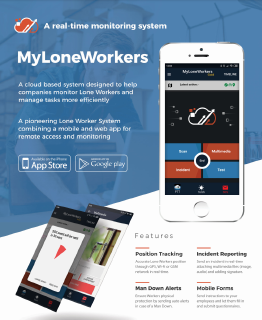
MyLoneWorkers delivers hotel panic button functionality as an integrated component of a comprehensive cloud-based lone worker safety platform — combining physical panic button hardware with a real-time monitoring dashboard, native Android and iOS mobile applications, and a full suite of complementary safety features designed for hospitality and other high-risk environments.
For hotel operators, MyLoneWorkers provides the most complete answer to the hotel panic button requirement — not as a standalone device, but as part of a connected safety ecosystem that protects every category of lone worker across the property.
The MyLoneWorkers External BLE Panic Button: Hotel Panic Button Hardware Built for the Field
The MyLoneWorkers external Bluetooth Low Energy (BLE) panic button is a compact, wearable device that connects to the MyLoneWorkers cloud platform in real time. Hotel staff — housekeepers, room attendants, maintenance engineers, night security personnel — carry the device as part of their standard equipment. In any situation where they feel unsafe or need immediate assistance, a single press dispatches a real-time SOS alert to the Monitoring Center, complete with the worker's identity and precise location.
Critically, the external BLE panic button operates independently of the worker's smartphone. In environments where accessing a phone quickly is impractical — carrying cleaning equipment, working in a confined plant room, or in any situation where speed is essential — the physical hotel panic button device provides an always-accessible, one-press emergency trigger. This is exactly the kind of reliable, low-friction alerting that buttons hotel environments demand.
The alert reaches the monitoring center dashboard and simultaneously triggers notifications to designated managers and contacts — ensuring that the response chain is activated immediately, through multiple channels, without any delay.
Test MyLoneWorkers for Free
Discover how MyLoneWorkers protects lone and field workers with man down alarms, real-time monitoring, and automated safety alerts. No installation or commitment required.
SOS Alert via the MyLoneWorkers Mobile App
For hotel staff who carry a smartphone as part of their role, the MyLoneWorkers mobile application provides a second hotel panic button layer — a digital SOS that workers can trigger directly from their device. The alert dispatches immediately to the Monitoring Center with precise GPS coordinates, and up to three designated contacts receive simultaneous SMS notifications.
The combination of physical BLE panic button and mobile SOS creates a redundant, dual-layer hotel panic button system — ensuring that workers always have access to an emergency alert mechanism regardless of their situation or the equipment they are carrying at any given moment.
Welfare Check: Scheduled Safety Monitoring for Hotel Staff
The Welfare Check feature adds time-based automated monitoring to the hotel panic button ecosystem. Managers define check-in intervals appropriate to each worker's role and risk profile — a housekeeper working a block of rooms, a security officer on an overnight patrol, a maintenance engineer working alone in a technical area.
If a worker fails to complete their check-in within the defined window, the platform immediately generates an alert and notifies managers via the web application and email. For hotel operations, this means that a worker who has been incapacitated — and who has not had the opportunity to press their hotel panic button — is still identified as requiring assistance within a defined and manageable time window.
Man Down Alert: Passive Protection Beyond the Hotel Panic Button
The Man Down feature extends hotel panic button protection into scenarios where a worker cannot act at all. A sensor clip worn on the worker's uniform continuously monitors movement and posture. When it detects that a worker has fallen, collapsed, or remained motionless in a position consistent with incapacitation, it automatically dispatches a Man Down notification to the Monitoring Center — without any action required from the worker.
For hotel environments where workers operate alone in rooms, corridors, and back-of-house areas, the Man Down sensor closes the most dangerous gap in any hotel panic button system: the scenario where a worker needs help but is physically unable to ask for it. The buttons hotel staff carry are essential, but passive detection ensures protection even when the button cannot be pressed.
Geofence Alerts: Location-Aware Safety for Large Hotel Properties
Hotels are large, complex environments with multiple floors, wings, service areas, and external spaces. The geofencing feature in MyLoneWorkers allows managers to configure virtual boundaries around specific zones — guest room floors, plant rooms, car parks, external service areas — generating automatic alerts when workers enter or exit defined areas.
For hotel security teams and duty managers, geofencing adds a continuous layer of passive situational awareness that complements the active hotel panic button system — providing an additional signal when workers are in higher-risk areas of the property.
Real-Time Checkpoint Scanning for Hotel Operations
Using NFC tags, Beacons, QR codes, and virtual checkpoints, hotel staff log their presence and task completion in real time via the MyLoneWorkers mobile application. Each scan sends timestamped GPS data to the web dashboard through a secure cloud server. Housekeepers can confirm room completions, maintenance engineers can log job sign-offs, and security personnel can record patrol progress — all within the same platform that manages their hotel panic button protection.
This operational data creates a rich, verifiable record of worker activity that complements the safety monitoring data and supports both compliance reporting and quality assurance.
AI Reports: Intelligence Across the Hotel Panic Button Platform
The AI Reports feature allows hotel managers and safety officers to interrogate the full history of hotel panic button activations, welfare check records, Man Down alerts, and safety incidents using natural-language questions — "How many SOS alerts were triggered this month?", "Which areas of the property generated the most incidents?", "List all missed welfare checks last week?" Instant, structured answers turn platform data into actionable safety intelligence.
For hotel groups managing multiple properties, AI-powered reporting makes it possible to identify risk patterns across sites and implement targeted improvements — without navigating complex dashboards or running manual data exports.
Optimize Your Scheduling with Workeen AI
Transform your workforce management with Workeen AI, the AI-powered shift management system designed to simplify scheduling for industries with round-the-clock operations. Effortlessly create efficient rosters, manage unexpected absences, and ensure fair work distribution with predictive insights and real-time updates. Boost productivity and compliance while keeping your team informed through instant communication tools.
Additional Features for Hospitality Operations
- Time & Attendance provides real-time tracking of shift check-ins, check-outs, working hours, and breaks — integrated within the same platform as the hotel panic button system, eliminating the need for separate HR tools.
- Asset Tracking allows managers to monitor physical assets — master keys, equipment, devices — tracking custody and return schedules. For hotels, where key management is both a security and an operational priority, this feature closes an important accountability gap.
- SafePass extends the MyLoneWorkers protection model to VIPs and designated guests or clients through a dedicated mobile application — supporting high-profile hotel guests with executive protection requirements or security obligations.
Why MyLoneWorkers Is the Right Hotel Panic Button Solution in 2026
For hotel operators evaluating hotel panic button systems in 2026, MyLoneWorkers stands apart through the depth and integration of its platform:
- Dual-layer alerting. Physical BLE panic button and mobile SOS work together — the buttons hotel workers carry are backed by a digital alert layer that operates independently.
- Passive protection. Man Down detection covers scenarios where the hotel panic button cannot be pressed — no single point of failure leaves a worker without coverage.
- Property-wide awareness. Geofencing, real-time location tracking, and checkpoint scanning provide complete visibility across large, complex hotel environments.
- Compliance built in.Automatic audit logging across all hotel panic button activations and safety events satisfies regulatory requirements without additional administrative effort.
- Operational integration. Attendance tracking, asset management, and AI reporting in a single platform — alongside the hotel panic button safety infrastructure.
Conclusion: Hotel Panic Button Systems Are No Longer Optional
In 2026, a hotel panic button system is not a differentiating feature for progressive hotel operators. It is the standard of care that regulators, insurers, and courts expect — and that hotel workers deserve.
MyLoneWorkers delivers the most complete hotel panic button and lone worker safety platform available for the hospitality sector — combining physical BLE panic button hardware, passive Man Down detection, welfare check automation, geofencing, and AI-powered reporting in a single cloud-based solution.
Because every member of your hospitality team — from the housekeeper on the fourteenth floor to the security officer on the night shift — deserves to know that help is one press away.
Explore MyLoneWorkers and request your free demo today.
About MyLoneWorkers
MyLoneWorkers innovative system reduces the risks and guarantees that every lone worker returns home safely after carrying out their tasks at work which is one of the most basic responsibilities for an employer. It is a real time lone worker monitoring system which skyrockets the efficiency of lone workers’ safety and the completion of their tasks offering them the ability to increase their productivity via technology.