How to Choose the Right Lone Worker Safety Device in 2026
Table of Contents
- Why the Right Lone Worker Safety Device Matters More Than Ever
- Types of Lone Worker Safety Devices
- Key Criteria for Choosing a Lone Worker Safety Device
- MyLoneWorkers: A Complete Lone Worker Safety Device Ecosystem
- How MyLoneWorkers Delivers Best-in-Class Safety for Lone Workers
- Additional Features That Complete the Safety for Lone Workers Picture
- Conclusion: Making the Right Choice in 2026
For businesses with employees working in isolation — on remote sites, in the field, during overnight shifts, or in hazardous environments — choosing the right lone worker safety device is one of the most consequential decisions a safety manager can make. The wrong choice leaves workers exposed. The right choice creates a reliable safety net that protects people, satisfies legal obligations, and gives management the real-time visibility they need to respond fast in an emergency.
In 2026, the market for working alone safety devices has expanded significantly. The options range from basic panic buttons to sophisticated cloud-connected platforms combining wearable hardware, mobile applications, and AI-driven monitoring. Understanding what differentiates a genuine lone worker safety device from an underpowered alternative — and knowing what questions to ask before committing to a platform — is essential for any business that takes safety for lone workers seriously.
This guide walks through everything you need to know to make the right choice.
Why the Right Lone Worker Safety Device Matters More Than Ever
Lone working is one of the most prevalent and least discussed occupational hazards in the modern economy. Security personnel, utility engineers, healthcare workers, field service technicians, construction workers, and delivery drivers all regularly work without a colleague nearby. When something goes wrong — a fall, a medical episode, a security threat — there is no one present to call for help, provide first aid, or even confirm that an incident has occurred.
The consequences of inadequate safety for lone workers are well-documented. Without a reliable lone worker safety device, the gap between an incident occurring and help arriving can stretch from minutes to hours. In many cases, that gap is fatal.
The regulatory environment reinforces the urgency. In the UK, the Health and Safety at Work Act and HSE guidance on lone working require employers to assess and control the specific risks faced by employees working alone. EU directives and OSHA standards in the United States impose comparable obligations. In 2026, regulators increasingly expect to see evidence of systematic monitoring — not just a risk assessment sitting in a drawer.
A purpose-built lone worker safety device — particularly one integrated with a cloud-based monitoring platform — provides both the protection workers need and the compliance documentation businesses require.
Types of Lone Worker Safety Devices
Before evaluating specific platforms, it helps to understand the main categories of working alone safety devices available in 2026:
Smartphone-based applications
The most widely deployed form of lone worker safety device uses the worker's existing Android or iOS smartphone as the primary hardware, supplemented by a dedicated safety application. These apps provide SOS alerting, GPS tracking, welfare check-ins, and — when integrated with cloud infrastructure — real-time monitoring. They are cost-effective to deploy and require no additional hardware for basic safety for lone workers.
Wearable sensor devices
For environments where passive detection is essential, wearable sensors — typically worn as a clip on a uniform or belt — continuously monitor the worker's movement and posture. When a fall or collapse is detected, the sensor automatically triggers a man-down alert without requiring any action from the worker. This is the most critical category of lone worker safety device for high-risk environments where incapacitation is a realistic risk.
Physical panic buttons
A dedicated lone worker safety device in the form of a compact, wearable panic button allows workers to trigger an SOS alert with a single press — without needing to access their smartphone. Bluetooth Low Energy (BLE) technology connects the button to the monitoring platform in real time. These devices are essential for environments where phone access is impractical under pressure.
Combined platform solutions
The most comprehensive approach to safety for lone workers integrates all three device types within a single cloud-connected platform — combining the smartphone app, wearable sensors, and physical panic button with centralized monitoring, welfare check automation, geofencing, and reporting. This is the category that defines best practice for working alone safety devices in 2026.
Key Criteria for Choosing a Lone Worker Safety Device
With multiple options available, how do you evaluate which lone worker safety device is right for your business? These are the criteria that matter most:
1. Passive vs. Active Detection
The most important question to ask about any lone worker safety device is: what happens when the worker cannot press a button? Active alerting — where the worker manually triggers an SOS — is essential but insufficient on its own. A complete solution for safety for lone workers must include passive, automated detection that responds to emergencies without requiring any action from the worker.
Man-down detection via wearable sensors is the gold standard. If the lone worker safety device you are evaluating does not include this capability, it has a critical gap.
2. Multi-Channel Alerting
When an alarm is triggered, the response chain must be immediate and redundant. A quality lone worker safety device platform should simultaneously alert the monitoring center, send notifications to the management dashboard, and dispatch SMS messages to designated contacts — ensuring that the right people are reached through multiple channels at the same time, regardless of who is available.
3. Location Accuracy
Working alone safety devices are only as useful as the location data they provide. When an emergency response team is dispatched, they need to know exactly where the worker is. Evaluate whether the lone worker safety device platform uses GPS alone or combines it with Wi-Fi and GSM triangulation — the latter provides significantly better accuracy in indoor environments, underground locations, and areas with poor satellite coverage.
4. Welfare Check Automation
Regular check-ins are a fundamental component of safety for lone workers, but manual processes are unreliable. The right lone worker safety device platform automates the welfare check cycle — sending scheduled prompts to workers and escalating automatically to managers when check-ins are missed. Silence must be treated as a warning signal, not an administrative gap.
5. Ease of Use Under Pressure
A lone worker safety device that is difficult to use in a stressful situation provides false reassurance. The interface — both on the mobile application and on any physical hardware — must be intuitive enough to operate correctly under pressure, with protective gear, and in poor lighting or adverse weather conditions.
6. Integration with Operational Tools
The best working alone safety devices do not exist as standalone safety tools. They integrate with scheduling, attendance tracking, asset management, and reporting — giving businesses a single platform for both safety and operational management. This integration reduces administrative overhead and ensures that safety data and operational data are aligned.
7. Cloud-Based Infrastructure
A cloud-based lone worker safety device platform requires no on-premise hardware installation, deploys rapidly, and scales without infrastructure investment. For businesses of any size, this reduces the total cost of ownership significantly and ensures that the platform is always up to date.
8. Compliance and Audit Logging
Every alert, check-in, location update, and management response should be automatically logged by the lone worker safety device platform, creating a timestamped compliance record that satisfies regulatory requirements and supports insurance and legal processes.
MyLoneWorkers: A Complete Lone Worker Safety Device Ecosystem
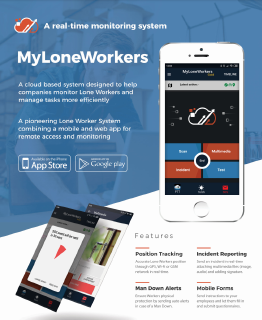
MyLoneWorkers is a cloud-based platform that delivers a complete lone worker safety device ecosystem — combining a smartphone application, wearable sensor hardware, a physical BLE panic button, and a real-time web management dashboard in a single integrated solution.
It is the lone worker safety device platform designed specifically for businesses with field operations and remote blue-collar workforces, and it has been built to meet every criterion that serious safety for lone workers demands.
Test MyLoneWorkers for Free
Discover how MyLoneWorkers protects lone and field workers with man down alarms, real-time monitoring, and automated safety alerts. No installation or commitment required.
How MyLoneWorkers Delivers Best-in-Class Safety for Lone Workers
The Man Down Sensor: The Most Critical Lone Worker Safety Device
The Man Down sensor clip is the hardware centrepiece of the MyLoneWorkers lone worker safety device ecosystem. Worn on the worker's uniform, it continuously monitors movement and posture. When a worker collapses, falls, or slips and is unable to reach their smartphone, the sensor automatically dispatches a Man Down notification to the Monitoring Center — triggering an immediate response without any action from the worker.
This passive, always-on detection is what makes MyLoneWorkers a complete lone worker safety device solution rather than a check-in tool with limitations. For any business where sudden incapacitation is a realistic risk — construction, utilities, security, healthcare — the Man Down sensor is non-negotiable.
The External BLE Panic Button: A Physical Lone Worker Safety Device for Demanding Environments
The external Bluetooth Low Energy panic button extends safety for lone workers into environments where smartphone access is impractical. Workers carry the compact device as part of their standard equipment. A single press sends a real-time SOS alert to the Monitoring Center immediately — no unlocking a phone, no navigating a menu, no fine motor tasks under pressure.
This physical lone worker safety device is particularly important for security personnel, industrial workers, and anyone operating in confined spaces or wearing heavy protective equipment. It ensures that working alone safety devices function in real field conditions, not just in ideal scenarios.
SOS Alert via Mobile Application
The MyLoneWorkers mobile application provides the primary active lone worker safety device interface. When a worker presses the SOS button, an immediate alarm is dispatched to the Monitoring Center with precise GPS coordinates. Up to three additional contacts receive simultaneous SMS notifications — creating a multi-channel response that reaches the right people instantly.
The Test Alert function allows workers to verify that the full lone worker safety device setup — device, connectivity, location data, and patrol configuration — is functioning correctly before a shift begins.
Welfare Check: Automated Safety for Lone Workers
The Welfare Check feature automates the structured safety for lone workers check-in cycle. Managers define time intervals appropriate to each worker's risk profile and assignment. When a worker misses a check-in, the platform immediately alerts managers via the web application and email. The lone worker safety device platform treats every missed check-in as a potential emergency — because it may be exactly that.
Geofence Alerts
Managers configure virtual geographic boundaries around job sites, restricted zones, and permitted working areas. The lone worker safety device platform alerts managers automatically whenever a worker enters or exits a defined geofence — providing continuous passive situational awareness alongside the active safety features.
Real-Time Checkpoint Scanning
Using NFC tags, Beacons, QR codes, and virtual checkpoints, workers log their presence and activity in real time. Each scan sends timestamped GPS data to the web dashboard. Workers can attach photos, voice notes, notes, and signatures — building an operational audit trail that complements the working alone safety devices data stream.
AI Reports
The AI Reports feature turns the continuous data generated by the lone worker safety device platform into immediately actionable intelligence. Managers ask natural-language questions — "Which workers missed check-ins this week?", "Show all SOS alerts in the last 30 days?" — and receive instant structured answers. For operations managers overseeing large dispersed teams, AI-powered reporting is an essential tool for proactive risk management.
Additional Features That Complete the Safety for Lone Workers Picture
MyLoneWorkers extends its lone worker safety device platform with operational tools that integrate safety and efficiency:
 Time & Attendance provides real-time shift tracking — check-in and check-out times, working hours, and breaks — fully integrated with the safety monitoring infrastructure.
- Asset Tracking registers and monitors physical assets, tracking custody, issue dates, and return schedules. Full accountability in one platform.
- SafePass extends the safety for lone workers model to VIPs and high-profile clients through a dedicated mobile application — supporting executive protection and client-facing security operations.
Optimize Your Scheduling with Workeen AI
Transform your workforce management with Workeen AI, the AI-powered shift management system designed to simplify scheduling for industries with round-the-clock operations. Effortlessly create efficient rosters, manage unexpected absences, and ensure fair work distribution with predictive insights and real-time updates. Boost productivity and compliance while keeping your team informed through instant communication tools.
Conclusion: Making the Right Choice in 2026
When evaluating working alone safety devices in 2026, the checklist is clear. You need passive man-down detection, active SOS alerting via both smartphone and physical hardware, automated welfare checks with escalation, accurate multi-technology location tracking, geofencing, compliance-grade audit logging, and a cloud-based platform that integrates safety with operational management.
MyLoneWorkers delivers every item on that list — in a single, rapidly deployable, field-proven platform.
The right lone worker safety device does not just react to emergencies. It prevents them from going undetected.
Explore MyLoneWorkers and request your free demo today.
About MyLoneWorkers
MyLoneWorkers innovative system reduces the risks and guarantees that every lone worker returns home safely after carrying out their tasks at work which is one of the most basic responsibilities for an employer. It is a real time lone worker monitoring system which skyrockets the efficiency of lone workers’ safety and the completion of their tasks offering them the ability to increase their productivity via technology.